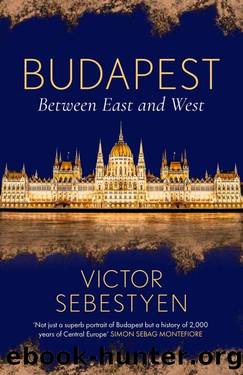
Budapest: Between East and West by Victor Sebestyen
Author:Victor Sebestyen [Sebestyen, Victor]
Language: eng
Format: epub
ISBN: 9781474610025
Publisher: Orion
Published: 2022-06-01T16:00:00+00:00
* * *
* Though this changed in the twentieth century after major development in parts of the Buda Hills and post-war housing estates in Ãbuda. Pest in 2021 housed around 70 per cent of the 1.7 million or so population of the city.
* In 1945 Andrássy út was renamed Stalin Avenue, then in 1956 the Avenue of the Peopleâs Republic, then in the 1980s it reverted to its original name. Landmarks along it changed too. A third of the way down the avenue thereâs a square where eight roads converge, including the main Ring. That was called Oktogon until 1934, when it was renamed Mussolini Circus, and changed back after the war. Further down towards the Peopleâs Park thereâs a pretty circus where four roads converge, originally called the Körönd. In 1940 it was renamed after Hitler, then after 1945 had its original name back, but since the 1970s has been known as Zoltán Kodály Körönd, after the composer who lived in a house on the avenue until his death in 1967.
* Ybl was the fashionable architect picked by the aristocrats and the nouveau riche for their mansions in Pest and estates in the country. Count István Károlyi used him to rebuild his beautiful neoclassical palace in Pest, as did a host of the finance oligarchs of the period. But his public commissions included the Basilica, the new St Stephenâs Cathedral, a stoneâs throw from the Opera House, and the near-complete rebuilding of the Royal Castle in Buda, including the Castle Garden, the Várket Bazár.
* Foreign performers who sang German, Italian or French parts in broken Hungarian, even when they misunderstood what they were singing, received enthusiastic applause and foot-stomping (and still do in the twenty-first century). Mahler was appalled that a professional singer would be so ill prepared. He hired Ede Ãjházi, an actor at the National Theatre, as language master to teach proper Hungarian pronunciation, not just to foreign stars but also to Hungarian performers who spoke with regional dialects.
* Mahler was not the last âforeignâ conductor to become musical director of the Opera House. After the Second World War the Communist regime appointed the great Otto Klemperer to the job. He had escaped Nazi Germany in the 1930s. He, too, was a brilliant success musically, who recreated the Opera House as an important venue with some exceptional musicians and singers. He established an excellent repertoire before he fell ill. He was hugely admired for his gifts but, as a Jew and a leftist, linked to a regime that was loathed, he was never a popular figure in Budapest.
* Bártók, on the other hand, disliked the works on musical grounds. âThe Hungarian Rhapsodies, which should say the most to us, are his least successful ⦠(perhaps that is why they are so generally known and admired),â he said.
Download
This site does not store any files on its server. We only index and link to content provided by other sites. Please contact the content providers to delete copyright contents if any and email us, we'll remove relevant links or contents immediately.
| Arms Control | Diplomacy |
| Security | Trades & Tariffs |
| Treaties | African |
| Asian | Australian & Oceanian |
| Canadian | Caribbean & Latin American |
| European | Middle Eastern |
| Russian & Former Soviet Union |
The Secret History by Donna Tartt(19088)
The Social Justice Warrior Handbook by Lisa De Pasquale(12190)
Thirteen Reasons Why by Jay Asher(8909)
This Is How You Lose Her by Junot Diaz(6886)
Weapons of Math Destruction by Cathy O'Neil(6279)
Zero to One by Peter Thiel(5801)
Beartown by Fredrik Backman(5754)
The Myth of the Strong Leader by Archie Brown(5507)
The Fire Next Time by James Baldwin(5444)
How Democracies Die by Steven Levitsky & Daniel Ziblatt(5218)
Promise Me, Dad by Joe Biden(5153)
Stone's Rules by Roger Stone(5087)
A Higher Loyalty: Truth, Lies, and Leadership by James Comey(4962)
100 Deadly Skills by Clint Emerson(4925)
Rise and Kill First by Ronen Bergman(4788)
Secrecy World by Jake Bernstein(4753)
The David Icke Guide to the Global Conspiracy (and how to end it) by David Icke(4717)
The Farm by Tom Rob Smith(4507)
The Doomsday Machine by Daniel Ellsberg(4490)
